 Indonesian Journal of Pharmaceutical Science and Technology
Nanocurcumin Mediated Modulation of Apoptotic Pathways in Cervical Cancer: A Systematic Review
Abstrak
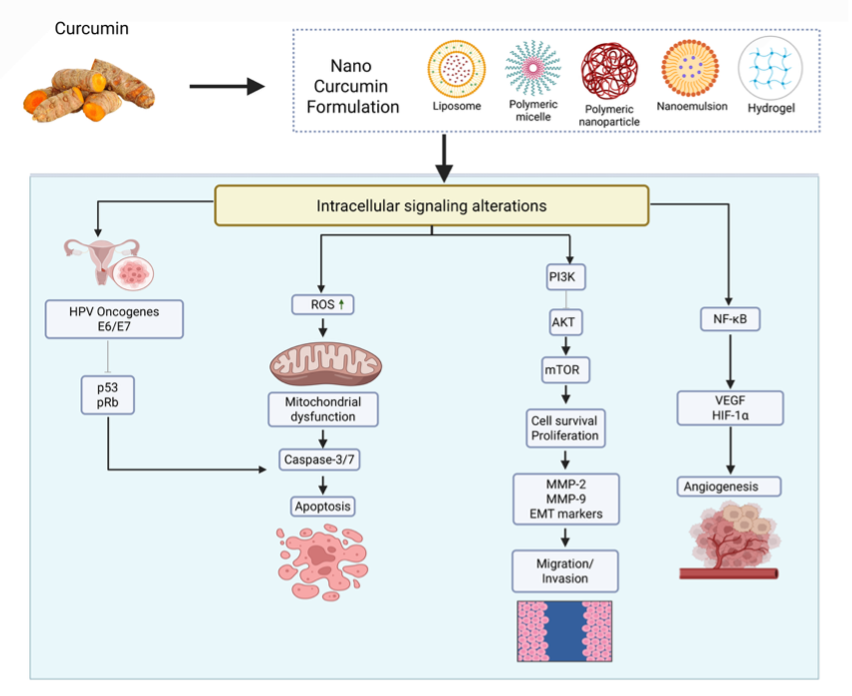
Cervical cancer is the fourth most common malignancy in women, driven largely by HPV oncoproteins E6 and E7, which degrade the tumor suppressors p53 and retinoblastoma protein and blunt apoptosis. Curcumin is pro-apoptotic but clinically limited by poor solubility, instability, and low bioavailability, motivating nanoformulation. This systematic review evaluated the apoptotic mechanisms, physicochemical characteristics, and preclinical efficacy of nanocurcumin in cervical cancer. Following PRISMA 2020, four databases (PubMed, Scopus, ScienceDirect, SpringerLink) were searched; 16 preclinical studies (2015–2025) met eligibility from 1,604 records. Nanocurcumin induced apoptosis through four convergent mechanisms: the intrinsic mitochondrial pathway (Bax/Bcl-2 modulation, caspase activation), ROS-mediated oxidative stress, suppression of HPV E6/E7 with restoration of p53 and Rb, and inhibition of PI3K/AKT/mTOR and NF-κB signaling. Formulations ranged from ~52 to 390 nm with encapsulation efficiencies often above 85%; folate receptor–mediated targeting gave the most reproducible uptake gains. Combination strategies consistently outperformed monotherapy in vivo, including extended survival. However, the near-absence of systemic pharmacokinetic and long-term toxicity data, non-representative models, and scalability challenges indicate that substantial development is needed before clinical evaluation.
Kata Kunci
Teks Lengkap:
PDF (English)Referensi
World Health Organization. Cervical cancer [Internet]. Geneva: World Health Organization; 2024 [cited 2026 Jun 22]. Available from: https://www.who.int/news-room/fact-sheets/detail/cervical-cancer
Ueda Y. Epidemiology of cervical cancer and HPV infection in Asia and Oceania. J Obstet Gynaecol Res. 2024;50(S1):31-41. doi:10.1111/jog.15943
Mayadev JS, Ke G, Mahantshetty U, Pereira MD, Tarnawski R, Toita T. Global challenges of radiotherapy for the treatment of locally advanced cervical cancer. Int J Gynecol Cancer. 2022;32(3):436-445. doi:10.1136/ijgc-2021-003001
Houpert R, Sylvestre E, Bouhnik AD, et al. Burden of cervical cancer in Martinique, 2012–2021. Cancer Epidemiol. 2025;97(June). doi:10.1016/j.canep.2025.102857
Burmeister CA, Khan SF, Schäfer G, et al. Cervical cancer therapies: Current challenges and future perspectives. Tumour Virus Res. 2022;13(February). doi:10.1016/j.tvr.2022.200238
Meyer M, Eksteen C, de Sousa C, et al. Personalised Medicine in Cervical Cancer: Evaluating Therapy Resistance Through Multi-Model Approaches. Cancer Med. 2025;14(13). doi:10.1002/cam4.70995
Jiang C, Shen C, Ni M, et al. Molecular mechanisms of cisplatin resistance in ovarian cancer. Genes Dis. 2024;11(6):1885-1895. doi:10.1016/j.gendis.2023.06.032
Zhang L, Liu W, Li Y, Fu Y, Xu C, Yu M. Polyphyllin I Sensitizes Cisplatin-Resistant Human Cervical Cancer Cells to Cisplatin Treatment. Nutr Cancer. 2024;76(7):656-665. doi:10.1080/01635581.2024.2350107
Ranasinghe V, McMillan N. Novel therapeutic strategies for targeting E6 and E7 oncoproteins in cervical cancer. Crit Rev Oncol Hematol. 2025;211(April):104721. doi:10.1016/j.critrevonc.2025.104721
Terkimbi SD, Paul-Chima UO, Mujinya R, Adesina KT, Ogar DA, Chukwudi EO, et al. Molecular, immunological and oncogenic mechanisms of cervical cancer mediated by HPV/HIV co-infection, clinical implication and management. Infect Agents Cancer. 2026;21:12. doi:10.1186/s13027-025-00729-0.
Cui D, Zhang C, Zhang L, et al. Natural anti-cancer products: insights from herbal medicine. Chinese Med (United Kingdom). 2025;20(1):1-91. doi:10.1186/s13020-025-01124-y
Kamau SW, Ngugi MP, Mwitari PG, Njeru SN. Network pharmacology, molecular docking and experimental approaches of the anti-proliferative effects of Rhamnus prinoides ethyl-acetate extract in cervical cancer cells. Heliyon. 2024;10(17):e37324. doi:10.1016/j.heliyon.2024.e37324
Zoi V, Kyritsis AP, Galani V, et al. The Role of Curcumin in Cancer: A Focus on the PI3K/Akt Pathway. Cancers (Basel). 2024;16(8):1-22. doi:10.3390/cancers16081554
Tabanelli R, Brogi S, Calderone V. Improving curcumin bioavailability: Current strategies and future perspectives. Pharmaceutics. 2021;13(10). doi:10.3390/pharmaceutics13101715
Kim JH, Dareowolabi BO, Thiruvengadam R, Moon EY. Application of Nanotechnology and Phytochemicals in Anticancer Therapy. Pharmaceutics. 2024;16(9). doi:10.3390/pharmaceutics16091169
Rahim UA, Mustapa M, Shakrin NNSM, et al. Current evidence and future direction on evaluating the anticancer effects of curcumin, gingerols, and shogaols in cervical cancer: A systematic review. PLoS One. 2024;19(11 November):1-24. doi:10.1371/journal.pone.0314280
Boroughani M, Moaveni AK, Hatami P, et al. Nanocurcumin in Cancer Treatment: A Comprehensive Systematic Review. Vol 15. Springer US; 2024. doi:10.1007/s12672-024-01272-x
Khan MA, Zafaryab M, Mehdi SH, Ahmad I, Rizvi MMA. Characterization and anti-proliferative activity of curcumin loaded chitosan nanoparticles in cervical cancer. Int J Biol Macromol. 2016;93:242-253. doi:10.1016/j.ijbiomac.2016.08.050
Jaiswal S, Mishra P. Co-delivery of curcumin and serratiopeptidase in HeLa and MCF-7 cells through nanoparticles show improved anti-cancer activity. Mater Sci Eng C. 2018;92(November 2017):673-684. doi:10.1016/j.msec.2018.07.025
Wang P, Sun X, Tang L, et al. CaCO3-encircled hollow CuS nanovehicles to suppress cervical cancer through enhanced calcium overload-triggered mitochondria damage. Asian J Pharm Sci. 2024;19(6):100989. doi:10.1016/j.ajps.2024.100989
Karimi M, Parsania M, Motakef Kazemi N, Qomi M, Hadipour Jahromy M. Curcumin nanoemulsion suppresses HPV oncogenes and inhibits cervical cancer progression: in vitro and in vivo study. Virol J. 2025;22:165. doi:10.1186/s12985-025-02738-2.
Wang WY, Cao YX, Zhou X, Wei B. Delivery of folic acid-modified liposomal curcumin for targeted cervical carcinoma therapy. Drug Des Devel Ther. 2019;13:2205-2213. doi:10.2147/DDDT.S205787
Xiong L, Wei Y, Si H, et al. Development of the Curcumin Analog CA7 Liposome and Its Evaluation for Efficacy Against Cervical Cancer in vitro and in vivo. Int J Nanomedicine. 2024;19:13411-13428. doi:10.2147/IJN.S493074
De Matos RPA, Calmon MF, Amantino CF, et al. Effect of Curcumin-Nanoemulsion Associated with Photodynamic Therapy in Cervical Carcinoma Cell Lines. Biomed Res Int. 2018;2018. doi:10.1155/2018/4057959
Luong D, Kesharwani P, Alsaab HO, et al. Folic acid conjugated polymeric micelles loaded with a curcumin difluorinated analog for targeting cervical and ovarian cancers. Colloids Surfaces B Biointerfaces. 2017;157:490-502. doi:10.1016/j.colsurfb.2017.06.025
Thulasidasan AKT, Retnakumari AP, Shankar M, et al. Folic acid conjugation improves the bioavailability and chemosensitizing efficacy of curcumin-encapsulated PLGA-PEG nanoparticles towards paclitaxel chemotherapy. Oncotarget. 2017;8(64):107374-107389. doi:10.18632/oncotarget.22376
Salehi R, Ebrahimi-Hosseinzadeh B, Hatamian-Zarmi A, et al. In situ forming thermosensitive vaginal hydrogels containing curcumin-loaded polymeric nanoparticles with their sustained release: rheological measurements and cytotoxicity effect on cervix cancer cell. Iran Polym J (English Ed. 2022;31(12):1495-1510. doi:10.1007/s13726-022-01093-1
Sadeghi RV, Parsania M, Sadeghizadeh M, Haghighat S. Investigation of Curcumin-Loaded OA400 Nanoparticle’s Effect on the Expression of E6 and E7 Human Papilloma-Virus Oncogenes and P53 and Rb Factors in HeLa Cell Line. Iran J Pharm Res. 2022;21(1):1-9. doi:10.5812/ijpr-130762
Nath S, Kubendiran H, Mukherjee A, Kundu R. Iron oxide-silver-curcumin nanocomposite acts against HPV16 positive cervical cancer cell siha by triggering crosstalk between autophagy and apoptosis primarily via breach in cellular redox equilibrium. Process Biochem. 2023;130(January):174-190. doi:10.1016/j.procbio.2023.04.011
Ma Y, Wang X, Zong S, et al. Local, combination chemotherapy in prevention of cervical cancer recurrence after surgery by using nanofibers co-loaded with cisplatin and curcumin. RSC Adv. 2015;5(129):106325-106332. doi:10.1039/c5ra17230f
Elbialy NS, Aboushoushah SF, Sofi BF, Noorwali A. Multifunctional curcumin-loaded mesoporous silica nanoparticles for cancer chemoprevention and therapy. Microporous Mesoporous Mater. 2020;291:109540. doi:10.1016/j.micromeso.2019.06.002.
Gawde KA, Sau S, Tatiparti K, et al. Paclitaxel and di-fluorinated curcumin loaded in albumin nanoparticles for targeted synergistic combination therapy of ovarian and cervical cancers. Colloids Surfaces B Biointerfaces. 2018;167:8-19. doi:10.1016/j.colsurfb.2018.03.046
Lakshmi BA, Reddy AS, Sangubotla R, Hong JW, Kim S. Ruthenium(II)-curcumin liposome nanoparticles: Synthesis, characterization, and their effects against cervical cancer. Colloids Surfaces B Biointerfaces. 2021;204(April):1-10. doi:10.1016/j.colsurfb.2021.111773
Alshehade SA, Almoustafa HA, Alshawsh MA, Chik Z. Flow cytometry-based quantitative analysis of cellular protein expression in apoptosis subpopulations: A protocol. Heliyon. 2024;10(13):e33665. doi:10.1016/j.heliyon.2024.e33665
Page MJ, McKenzie JE, Bossuyt PM, Boutron I, Hoffmann TC, Mulrow CD, et al. The PRISMA 2020 statement: An updated guideline for reporting systematic reviews. BMJ. 2021;372:n71. doi:10.1136/bmj.n71
Salehi R, Ebrahimi-Hosseinzadeh B, Hatamian-Zarmi A, Sahraeian R, Alvandi H, Mokhtari-Hosseini ZB, et al. In situ forming thermosensitive vaginal hydrogels containing curcumin-loaded polymeric nanoparticles with their sustained release: rheological measurements and cytotoxicity effect on cervix cancer cell. Iran Polym J (English Ed [Internet]. 2022;31(12):1495–510. Available from: https://doi.org/10.1007/s13726-022-01093-1
Alshehade SA, Almoustafa HA, Alshawsh MA, Chik Z. Flow cytometry-based quantitative analysis of cellular protein expression in apoptosis subpopulations: A protocol. Heliyon [Internet]. 2024;10(13):e33665. Available from: https://doi.org/10.1016/j.heliyon.2024.e33665
DOI: https://doi.org/10.24198/ijpst.v13i2.71396
Refbacks
- Saat ini tidak ada refbacks.
| Switch to English Back to Top |
| View My Stats Penerbit Universitas Padjadjaran
Jurnal ini terindeks di : Creative Commons Attribution :
Based on a work at http://jurnal.unpad.ac.id/ijpst/ |