


.png)

- Focus and Scope
- Section Policies
- Peer Review Process
- Publication Frequency
- Open Access Policy
- Archiving
Focus and Scope
Jurnal Kedokteran Gigi Universitas Padjadjaran is an open-access journal published in English that disseminates original, innovative, up-to-date, and applicable research articles and case reports across all fields of dental science, employing interdisciplinary and multidisciplinary approaches. All manuscripts are subjected to a double-blind peer review system to ensure the dissemination of high-quality scientific knowledge and its practical applications in accordance with established scholarly standards.
The journal is published by the Faculty of Dentistry, Universitas Padjadjaran three times a year, in April, August, and December. Manuscript submission is open throughout the year and is conducted via the Open Journal System (OJS). Jurnal Kedokteran Gigi Universitas Padjadjaran is also affiliated with the Indonesian Dental Association (Persatuan Dokter Gigi Indonesia / PDGI), as stipulated in a Memorandum of Agreement (MoA).
The scope of Jurnal Kedokteran Gigi Universitas Padjadjaran encompasses all areas of dental science, including but not limited to: oral biology; dental materials science and technology; oral and maxillofacial surgery; pediatric dentistry; community dental health, epidemiology, and preventive dentistry; conservative dentistry, endodontics, and operative dentistry; periodontology; prosthodontics; orthodontics; oral medicine; dental and maxillofacial radiology; as well as the development of dental science through related scientific disciplines.
The journal accommodates scholarly works in dentistry from academic, research, and clinical practice perspectives, serving as a scientific reference across all branches of dental science.
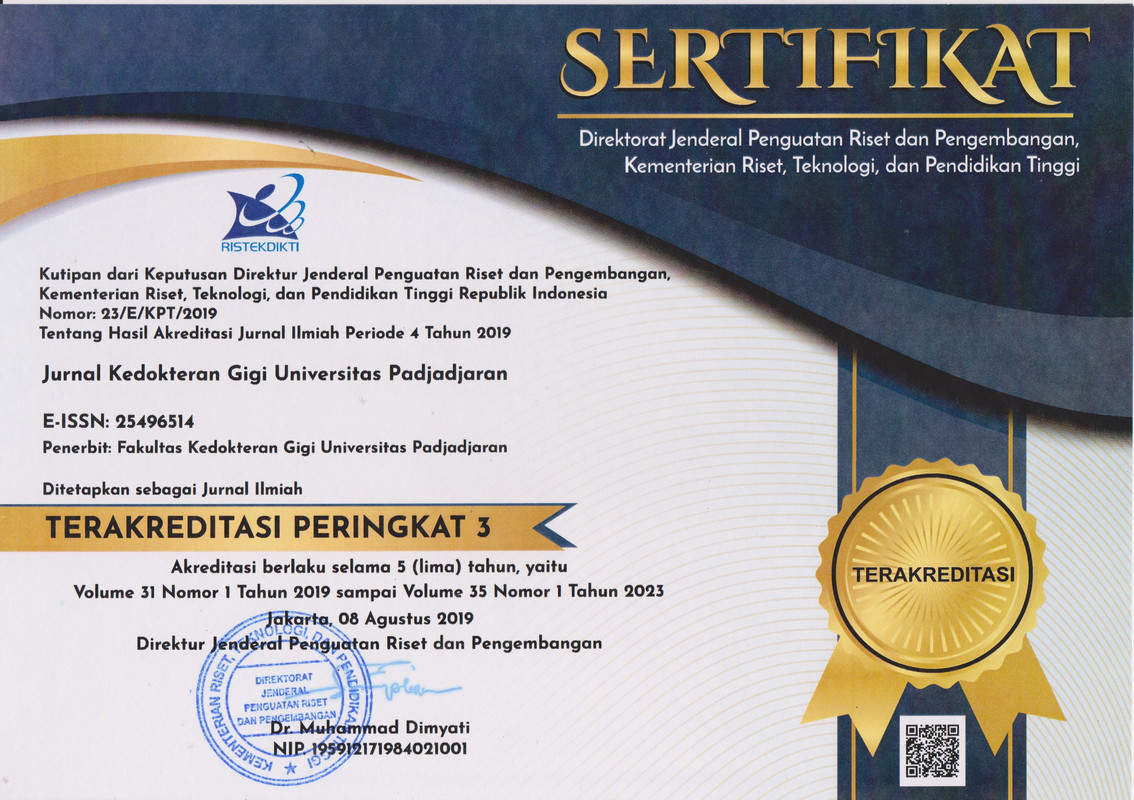
Jurnal Kedokteran Gigi Universitas Padjadjaran is a sister journal of the Padjadjaran Journal of Dentistry© (p-ISSN: 0854-6002). Since 2017, the journal has been available in an online publication format with e-ISSN 2549-6514, in accordance with PDII–LIPI policies. In the same year, the journal adopted the Open Journal System (OJS) platform, requiring all authors to register prior to submitting manuscripts online. Manuscript management, peer review, and editorial processes are conducted exclusively through this platform, allowing authors to track the progress of their submissions.
Manuscripts submitted to Jurnal Kedokteran Gigi Universitas Padjadjaran undergo an initial screening process aimed at ensuring manuscript suitability and supporting early-career and mid-level researchers in developing high-quality scientific writing. This is followed by a double-blind peer review process to ensure compliance with rigorous scientific standards.
Prior to submission, authors must ensure that their manuscripts adhere to the journal templates and that all required manuscript files and author metadata are completed accurately and comprehensively. Submissions that do not meet these requirements will not be considered for further processing. All submitted manuscripts are screened for plagiarism using Turnitin to prevent any form of unacceptable plagiarism. Reference management is recommended using Mendeley, following the Vancouver superscript citation style. All selected keywords must be based on Medical Subject Headings (MeSH) terms.
A Submission Acknowledgement will be automatically sent to the registered email address for each manuscript submission. This acknowledgement includes a Cover Letter detailing the required documentation, along with a Statement of Willingness to Pay the Initial Processing Charge, which must be completed. The Journal Publishing Agreement—including the Authorship Statement, Copyright Transfer Agreement, and Conflict of Interest Disclosure—as well as the Article Publication Fee Form and Letter of Acceptance, will be issued only after the manuscript has been formally accepted.
All submitted manuscripts undergo an initial editorial assessment, followed by double-blind peer review and editorial copyediting. Editorial practices at Jurnal Kedokteran Gigi Universitas Padjadjaran strictly adhere to the ICMJE Recommendations for the Conduct, Reporting, Editing, and Publication of Scholarly Work in Medical Journals. The double-blind peer review process follows the RDDA (Related Discipline, Different Affiliation) principle and complies with the journal’s Ethical Guidelines for Peer Reviewers. All publication policies and practices are rigorously aligned with COPE standards for publication ethics.
Further information regarding Jurnal Kedokteran Gigi Universitas Padjadjaran is available in the Journal History section.
Section Policies
Articles
 Open Submissions Open Submissions |
Indexed |
Peer Reviewed |
Case Report
| Open Submissions |
Indexed |
Peer Reviewed |
Bandung Dentistry 2019
| Open Submissions |
Indexed |
Peer Reviewed |
Bandung Dentistry 2022
| Open Submissions |
Indexed |
Peer Reviewed |
SINI 2022
IKORGI (SINI) 2022
| Open Submissions |
Indexed |
Peer Reviewed |
DIES FORUM 2022
| Open Submissions |
Indexed |
Peer Reviewed |
International Collaboration Article
| Open Submissions |
Indexed |
Peer Reviewed |
Ph Day 2023
| Open Submissions |
Indexed |
Peer Reviewed |
SINI 2024
| Open Submissions |
Indexed |
Peer Reviewed |
International Collaboration Case Report
| Open Submissions |
Indexed |
Peer Reviewed |
Ph Day 2025
| Open Submissions |
Indexed |
Peer Reviewed |
Simposium Ilmiah Bandung PerioAcademy 2.0
Simposium Ilmiah Bandung PerioAcademy 2.0
| Open Submissions |
Indexed |
Peer Reviewed |
Ph day 2026
| Open Submissions |
Indexed |
Peer Reviewed |
Peer Review Process
Jurnal Kedokteran Gigi Universitas Padjadjaran (JKG) is a double-blind peer-reviewed journal. Every paper submitted to JKG for publication is subject to peer review. The peer review in this journal is an evaluation of the submitted paper by two or more individuals of similar competence to the author. It aims to determine the academic paper's suitability for publication. The peer review method is employed to maintain standards of quality and provide credibility for the papers. The peer review at JKG proceeds in 9 steps with the description as follows.
1. Submission of Paper
The corresponding or submitting author submits the paper to the journal. This is carried out via an online system supported by the Open Journal System (OJS). To facilitate authors, JKG temporarily also accepts paper submissions by email.
2. Editorial Office Assessment
The submitted paper is first assessed by the JKG editor. The editor checks whether it is suitable for the journal's focus and scope. The paper's composition and arrangement are evaluated against the journal's Author Guidelines to make sure it includes the required sections and stylizations. In addition, an assessment of the minimum required quality of the paper for publication begins at this step, including one that assesses whether there is a major methodological flaw. Every submitted paper that passes this step will be checked by Turnitin to measure the similarity index which leads to plagiarism before being reviewed by reviewers.
3. Appraisal by the Editor-in-Chief
The Editor-in-Chief checks if the paper is appropriate for the journal, sufficiently original, interesting, and significant for publication. If not, the paper may be rejected without being reviewed any further.
4. Invitation to Reviewers
The handling editor sends invitations to individuals who he or she believes would be appropriate reviewers (also known as referees) based on expertise, the closeness of research interest, and no conflict of interest consideration. The peer review process at JKG involves a community of experts who are qualified and able to perform reasonably impartial reviews. The impartiality is also maintained by the double-blind peer review employed in this journal. That said, the reviewer does not know the author's identity; conversely, the author does not know the reviewer's identity. The paper is sent to reviewers anonymously.
5. Response to Invitations
Potential reviewers consider the invitation against their own expertise, conflicts of interest, and availability. They then decide to accept or decline. In the invitation letter, the editor may ask the potential reviewer for the suggestion of an alternative reviewer when he or she declines to review.
6. Review is Conducted
The reviewers allocate time to read the paper several times. The first read is used to form an initial impression of the work. If major problems are found at this stage, the reviewers may feel comfortable rejecting the paper without further work. Otherwise, they will read the paper several more times, taking notes so as to build a detailed point-by-point review. The review is then submitted to the journal, with a recommendation to accept or reject the paper, or with a request for revision (usually flagged as either major or minor) before it is reconsidered.
7. Journal Evaluates the Reviews
The Editor-in-Chief and handling editor consider all the returned reviews before making an overall decision. If the reviews differ widely between both reviewers, the handling editor may invite an additional reviewer to obtain an extra opinion before making a decision.
8. The Decision is Communicated
The editor sends a decision email to the author including any relevant reviewer comments. Reviewer comments are sent anonymously to the corresponding author to take the necessary actions and responses. At this point, reviewers are also sent an email or letter letting them know the outcome of their review.
9. Final Steps
If accepted, the paper is sent to copy-editing. Suppose the article is rejected or sent back to the author for either major or minor revision. In that case, the handling editor will include constructive comments from the reviewers to help the author improve the article. The author should make corrections and revise the paper according to the reviewers' comments and instructions.
After revision has been made, the author should resubmit the revised paper to the editor.
If the paper was sent back for revision, the reviewers should expect to receive the revised version, unless they have opted out of further participation. However, where only minor changes were requested, this follow-up review might be conducted by the handling editor.
If the editor is satisfied with the revised paper, it is considered accepted. The accepted papers will be published online and are freely available as downloadable PDF files.
Publication Frequency
Currently published tri-annual (April, August and December).
Open Access Policy
This journal provides immediate open access to its content on the principle that making research freely available to the public supports a greater global exchange of knowledge.
This journal is open access journal which means that all content is freely available without charge to users or / institution. Users are allowed to read, download, copy, distribute, print, search, or link to full text articles in this journal without asking prior permission from the publisher or author.
Archiving
This journal utilizes the Directory of Open Access Journals (DOAJ) system to create a distributed archiving system among participating libraries and permits those libraries to create permanent archives of the journal for purposes of preservation and restoration.
 All publications by the Universitas Padjadjaran [e-ISSN: 2549-6514, p-ISSN: 0854-6002] are licensed under a Creative Commons Attribution-NonCommercial 4.0 International License.This license requires that reusers give credit to the creator. It allows reusers to distribute, remix, adapt, and build upon the material in any medium or format, for noncommercial purposes only.